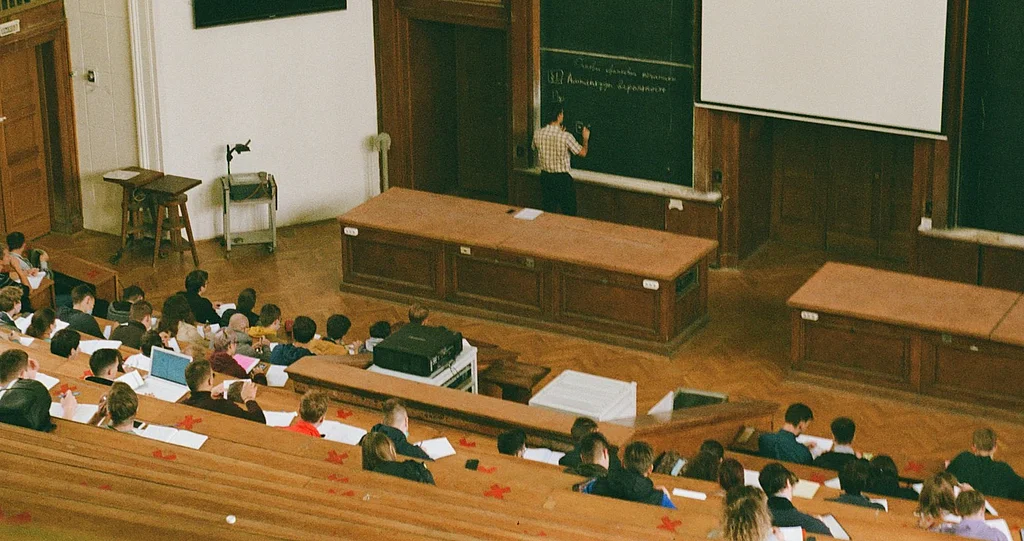
I can still remember those career days we used to have at school. Sometimes we'd go somewhere, sometimes people would come to our school and tell us about their jobs. The path was almost always the same. It started with school, then university or an apprenticeship. After that came the first job, maybe a few more jobs after that, and eventually people started calling it a career.
What nobody told me back then was that this whole equation assumes that the job you're preparing for will still look roughly the same five years later.
So what's the point of figuring out your career early if you don't even know what that career will look like by the time you get there?
I don't think that assumption really works anymore.
5 years is a long time
It's 2026 and someone is graduating from school and starting university at 18. They'll probably have their bachelor's degree around 2029 and their master's around 2031.
Now think about the technological jump we've seen over the last five years.
ChatGPT wasn't even publicly released until the end of 2022. In less than four years, generative systems went from relatively simple chatbots to tools that can write large amounts of code, do research, generate images and videos, and do a lot of other things.
Someone graduating from school today has to make decisions for a job market that won't exist until 2030 or 2031.
And that job market could look very different from the one they're looking at right now.
Some examples
Let's just take a few professions.
Software development
This is obviously the easiest one for me.
Imagine starting a computer science degree today because you want to become a software developer. You start learning programming fundamentals, algorithms, databases, software engineering, web development and so on.
And of course those things still mater. But think about what someone imagined a software developer doing five years ago.
You get a ticket. You open your editor. You write the implementation. You spend an hour trying to figure out why something doesn't work. You search Stack Overflow. You write some tests (maybe). Eventually you find the stupid mistake you made three hours ago.
That's how I learned a lot of what I know.
Today I can give an AI a description of a problem and get a surprisingly decent implementation back. I can give it an error message and ask what's wrong. I can give it existing code and ask it to write tests for it.
That doesn't mean software developers are disappearing. Someone still has to understand what should be built, how it fits into everything else, whether the generated code actually makes sense and what happens when it doesn't.
But that's kind of my point. If you start studying computer science today because you want to become a software developer, the job you'll get in five years might still be called "Software Developer". I'm just not sure you'll spend your day doing the things you currently associate with that title.
Writing, translation and marketing
Writing is probably the most obvious example because we're already surrounded by it.
I have no idea how much of what I read online today was written by a person, written by AI, or written by a person and then rewritten by AI. And honestly, most of the time I can't tell anymore.
Take translation. A translator could spend hours translating a document. Today you can paste the same document into a model and get a translation back in seconds. Is it always correct? No idea. And depending on what you're translating, "probably correct" is obviously not good enough.
And the same thing happens with marketing copy, product descriptions, emails and all the other little pieces of writing companies produce every day.
Maybe one marketer can produce the amount of material that used to require three. I don't know. But if you're starting a degree today because you want to do one of these jobs, that's a pretty important "I don't know".
AI probably won't simply take the jobs
I think this is an important distinction because the data doesn't really support the simple "AI replaces everyone" argument.
The ILO says that about one in four workers worldwide has a job that involves using generative AI to some extent. But it's probably not a complete replacement. It's transformation (source).
To be fair, that's based on their 2025 report. And with how quickly things are moving, even data from last year is already old.
Most jobs probably won't disappear overnight. The actual work just starts to look different.
I can already see that with programming. I give Claude something to implement, do something else for a while and come back to mostly finished code. Then I spend my time figuring out what it got wrong instead.
The junior problem
If we extend the equation from earlier, a traditional career looks something like this:
Beginner, simple tasks, mistakes, experience, harder tasks, expert.
Simplified obviously. But that's how we learn. The problem is that AI is particularly good at many of the tasks we've traditionally given to beginners. Take software development as example.
A junior developer might work on simple implementations, boilerplate, tests, documentation or smaller tickets. Those tasks aren't just cheap work that someone has to do. They're also how you get into the workflow, make mistakes, understand systems and slowly learn how everything fits together.
A senior developer deals more with architecture, ambiguous problems, legacy systems, stakeholder communication, trade-offs, and responsibility.
But you don't just wake up one morning and become senior. You get there by doing the simpler work first. So what happens when we automate the work that people used to learn on? Or maybe the better question is: How do you become senior if nobody needs you to be junior?
A Stanford analysis updated in August 2026 looked at millions of US payroll records and found no broad AI-driven collapse in employment. But employment among 22-to 25-year-olds in jobs with a lot of AI was about 19 percent below what it would have been if it had grown like employment among their peers in less AI-exposed jobs.
It seems like the difference mostly comes from companies hiring fewer young people. That doesn't prove AI caused it though.
But developers don't have to lose their jobs for this to become a problem. If companies need fewer juniors, fewer people get those first few years of experience they need to become seniors.
Maybe university was never about learning a job
A computer science degree shouldn't just teach you a specific technology like React. Just like a law degree isn't only about writing contracts and a design degree isn't only about learning Photoshop.
University teaches fundamentals, mental models, critical thinking, domain knowledge and hopefully the ability to learn.
I mean, of course we're not going to university just to learn how to do one specific task at one specific company.
If React disappears tomorrow, my computer science degree doesn't become useless. I still learned a lot of things that have nothing to do with React.
But… at some point, education has to turn into skills that someone is willing to pay for. And it's getting harder to know what those skills will be five years from now.
AI will create jobs too
The World Economic Forum expects major changes in the job market by 2030, but not a collapse. Its 2025 report estimates that 170 million jobs could be created while 92 million could be displaced. That's a net increase of 78 million jobs.
At the same time employers surveyed for the report expect almost 40 percent of the skills required at work to change by 2030.
170 million new jobs sounds pretty good. The problem is that an 18-year-old can't study for a job that doesn't exist yet.
So even if AI creates more jobs than it destroys, you still have the same problem when you're trying to decide what to do with your life now.
Maybe we're optimizing for the wrong thing
The classic question is usually: "What do you want to be when you grow up?"
I think that question is outdated. It assumes that you choose something, become good at it, and then more or less keep doing it. Maybe at different companies, maybe with more responsibility, but the basic idea stays the same.
Maybe putting so much weight on the job title is the problem.
Saying "I'm a programmer" and saying "I know how to understand problems and build software to solve them" are two very different things. The first describes a job. The second is something I can still use if the job changes.
I don't know if I'll spend most of my day writing code five or ten years from now. Maybe I'll spend more time describing what I want software to do (which is very boring in my opinion). Maybe programming becomes much more about reviewing and architecture. Maybe something completely different happens.
I have no idea. And that's kind of the problem with planning it.
The strange thing about being in your twenties
The twenties are already a weird time.
You're supposed to figure out where you want to live, what kind of people you want around you, how to deal with money, what you actually care about, and somehow also what you want to spend the next forty years doing for work.
And you're supposed to make a lot of those decisions with very little experience. Career always seemed like one of the things you could at least somewhat plan. Study this. Become that. Get better at it. Move up. Well, that seems a bit less likely now.
I'm studying computer science while the way we build software is changing in front of me. Some of the things that seemed difficult when I started programming can now be done by an AI in a few seconds.
And I don't think that's necessarily a bad thing. I use these tools myself. They can make me faster and they can take away work I never enjoyed doing in the first place. But it does make me wonder what exactly I'm preparing for. I'm pretty sure people will still build software when I'm 30. My role in building it? I don't know.
So what are you supposed to do?
The obvious answer would probably be something like: learn AI.
And sure, that's probably useful right now. But five years ago the advice would have been different and five years from now it'll probably be different again. So replacing one thing you have to keep up with with another one doesn't really solve the problem.
I don't think anything is really future-proof then. You learn something, it becomes useful, things change and you learn something else. Knowing the fundamentals probably makes that easier. So does actually building things and figuring out why they work instead of just learning whatever tool happens to be popular right now.
And you'll probably have to do that more than once.
The World Economic Forum report I mentioned earlier doesn't only predict increasing demand for AI and technology skills. Employers also expect things like creative thinking, resilience, flexibility and collaboration to become more important.
Which makes sense. Being really good at one tool only gets you so far when everything keeps changing. At some point you just have to get used to learning new ones.
A bad time to plan your life
Back in school, the question was always what I wanted to become. Chef. Developer. Engineer. Whatever. It seemed like there was a right answer somewhere and I just had to figure it out.
I don't really believe that anymore. I can decide what I want to do next. I'm much less convinced that I can decide what I'll still be doing ten or twenty years from now. I might make the right decision at 18 and still end up doing something completely different at 25.
That doesn't make the decision pointless. You still have to start somewhere. It just means you're probably going to make that decision more than once. The further ahead you try to plan, the more assumptions you have to make about a world that's changing while you're making them.
You probably won't guess where you'll be in ten years anyway. Things will turn out differently than you expected, and you'll have to figure it out as you go.