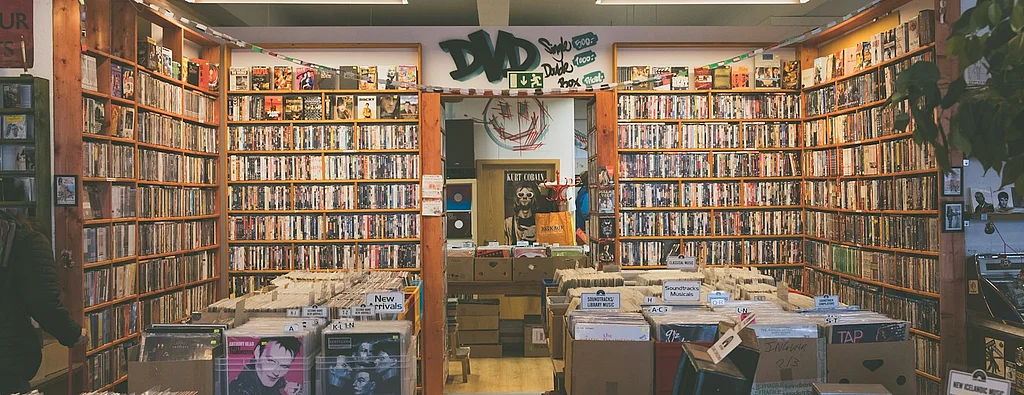
Ok, I don't actually miss DVDs that much. I definitely don't miss being afraid of scratching them. Whenever I took out a new DVD, I always felt like I was performing surgery and was only allowed to touch the thing with my fingertips. And definitely not with my nails. I also don't miss having a cabinet that's almost bursting because there's no space left for DVDs. I mean sure, maybe I have a whole cinema room in the future and plenty of space for DVDs. If I imagine having to fit all the movies I've already watched this year into my current room, I could probably sleep on top of the cases. And waiting four days for a DVD to arrive? Never. So I think we can conclude one thing: Streaming is much more convenient. Netflix is a good example: Netflix started with a DVD-by-mail service. It reached around 14 million subscribers in 2011. By 2019, that number had dropped to only 2.1 million, and eventually, in 2023, the service was shut down after 25 years. So I'd say: I mostly miss the things that disappeared with DVDs.
You owned your movies
Think about it: A DVD is a one-time transaction. You give someone €10. They give you the movie. Transaction over. You don't need an account, recurring payments, or licensing agreements that change depending on your region. No internet connection and no company deciding whether the movie will still be available next year. Put The Lord of the Rings on your shelf in 2005 and, if the disc still works, you still have it today.
Streaming changed this process. Actual ownership became access. And subscriptions changed it from ownership to temporary access to a changing catalog. Take Amazon's licensing documentation as an example. Access is explicitly tied to the period in which someone qualifies as a subscriber. A "Digital Purchase", on the other hand, allows you to stream something repeatedly.
Since I personally think winter is the best season, let's use that for our example. I watch the same movie every Christmas. With a DVD, I ask myself: Where did I put it last year? If I want to stream the movie, I ask myself: Which service has it? Is it included? Is it somewhere else? Do I have to rent it? Is it even available in Germany?
Physically owning the DVD solved the problem of finding the movie.
A movie collection is an identity
I think this is one of the biggest things we lost. Imagine you're visiting a friend. You walk into their room and see this on their shelf: Star Wars, Fight Club, Harry Potter, some Japanese movie, every season of The Simpsons, and a questionable comedy that probably wouldn't even be made today. That collection is autobiographical. It tells you something about that person.
Our collections were part of our physical identity. Books mostly still are, vinyl records are, games sometimes are too, but with movies it mostly stops there. I wouldn't really describe my Netflix homepage as my collection. Maybe it's Netflix's collection, rearranged for me every once in a while.
"Come and look at my collection" just sounds better to me than "Come and look at my Netflix watch history." I mean, they probably contain the same information, but one is a collection and the other is telemetry.
I know that today we share Letterboxd profiles, Spotify Wrapped, playlists, and all of that. I do it myself. Digital identity is replacing physical identity. And maybe a Letterboxd profile tells you much more about someone than a shelf full of DVDs ever could.
And I understand that point, but I still think there's a difference between curation and ownership. A Letterboxd profile says: "These are movies I like." A shelf says: "These movies mattered enough to me that I decided to keep them."
The consequences of choosing a movie
When you rented or bought a movie, you already made your first decision before pressing "Play."
If you walk around a store for 20 minutes and then pay €3 for The Matrix, you're probably going to watch The Matrix afterwards.
Streaming is pretty much the opposite and you can just constantly switch back and forth. Don't like the movie after ten minutes? Back. Scroll. Trailer. Back. Open another app and so on. And suddenly you're back to spending another 35 minutes trying to find a movie.
Now imagine going back to a time when you only had 20 DVDs. You probably watched some of them more than five times. Not because they were the 20 greatest movies ever made, but because they were simply there. Unlimited choice on the other hand means you don't really have to watch them again.
Maybe that's just bias though. Maybe I simply remember the good DVDs. Maybe I just forgot about the bad ones. I still had to watch those because I had already paid for them. That's where streaming has the advantage that we can simply avoid bad entertainment.
But did removing the cost of switching help us find things we enjoy more, or did it just make us better at giving up on things before we start enjoying them?
We gained infinite choice and created a new problem
I think the problem here is that during the DVD era, we only had the problem that we couldn't watch a movie because we didn't have it. In the streaming era, we can watch thousands of movies, but we don't know which one.
Streaming didn't really solve scarcity. Scarcity just moved from content to attention. There aren't too few movies anymore. There are too many movies competing for two free hours.
Ok, recommendation algorithms are supposed to solve that. Netflix doesn't show you its entire catalog. It predicts which movies you might actually like. And yes, without streaming, it would be much harder to discover international niche movies, documentaries, or old TV shows. That's a huge improvement.
While recommendation systems reduce the amount of searching we have to do, they come with the trade-off that platforms increasingly decide which movies are shown to us. With DVDs, discovery happened through friends, stores, magazines, television, and so on.
The extras of DVDs
I almost forgot this was even a thing, but DVDs used to include deleted scenes, bloopers, director commentary, behind-the-scenes footage, interviews, and concept art. You didn't just get the movie. You got a small archive of what made the movie.
For example, if you're interested in filmmaking, you can watch a DVD with director commentary and learn things that could theoretically come close to a two-hour lecture. And all of that in one movie.
Some streaming services offer extras as well but it's not a fundamental part of streaming (and it probably never will be).
But couldn't you just watch all of this stuff on YouTube? Yes, and maybe YouTube actually improved this. Today you can find almost anything there, whether it's cast interviews or something else, and most of it is free. The difference is the context. The DVD gives you the movie and then shows you how the movie was made. The modern internet gives you the movie and says: Go search another platform if you're interested. So the information didn't really disappear, but the package it originally came in did.
Better quality
A normal DVD is obviously worse than 4K streaming. Physical 4K Blu-rays, however, can offer much higher bitrates and lossless or uncompressed audio formats compared to heavily compressed streaming. That's one of the reasons current 4K Blu-ray hardware is still attractive to enthusiasts.
Streaming has bandwidth limitations. Physical media doesn't have to optimize transmission across millions of internet connections at the same time. So somehow, the supposedly "outdated" way of watching a movie can still technically be the better one.
Of course, a lot of people probably don't care. Streaming quality is good enough for most people. Many probably wouldn't even notice the difference. A 4K disc, a player, a good TV, and then a sound system on top of that takes effort and costs a lot of money. Simply opening Netflix on a €500 TV is probably much more attractive to most people than thinking about bitrates. In the end, convenience wins again.
Streaming libraries aren't archives
Streaming makes it feel like every movie ever made is online. But it isn't. Netflix's DVD catalog apparently had around 100,000 titles at its peak. And one reason people kept using it until the end was that it gave them access to obscure, classic, and foreign movies that weren't available through mainstream streaming.
Streaming platforms optimize their catalogs for economic reasons. I mean, that's understandable. They're companies after all. But commercial availability and cultural preservation are two different goals. A movie that only a few people watch might not justify licensing costs, digitization, operations, or whatever else is required. A physical copy doesn't care whether anyone else wants it.
Imagine only 2,000 people in the entire world still care about some mediocre movie from 1987. Commercially? Almost irrelevant. Culturally? Those 2,000 people might still want it to be preserved.
A DVD sitting around in someone's home doesn't have to justify its monthly existence to an algorithm or a licensing department.
Maybe some of you are thinking now: Didn't physical media have exactly the same problem? Yes, that's true. Studios stopped producing obscure DVDs. Discs degrade. Players disappear. Rare releases become expensive. And streaming can actually save some of this content because distributing one additional digital copy costs very little.
Neither commercial streaming nor physical media alone is an acceptable system for preservation. So the real question isn't: DVD vs. Netflix. It's: Who preserves culture when preserving it isn't profitable?
Streaming won for very good reasons
Streaming gives us immediate access. You think of a movie and could theoretically be watching it ten seconds later. Hundreds of movies on streaming platforms don't take up an entire wall. Then there's the portability you get. You can watch on your TV, your laptop, your phone on the train, or pretty much anywhere else. Streaming also gives us accessibility: You can watch shows in their original language and you have audio descriptions. And you don't have to spend €10–30 every single time you want to try something new.
Netflix's history makes this even more obvious. The DVD business kept shrinking until maintaining it no longer made economic sense, while streaming became the core product. That's simply a fact. DVDs lost the fight because streaming solved real problems.
But convenience isn't free
So yes, streaming won. And for good reasons.
But I think we often look at technological progress like this: There is an old solution, then someone invents a new solution, and suddenly we basically have the same thing, just better.
DVDs became streaming. Streaming is more convenient. Therefore, streaming is better. But it wasn't that simple. We didn't replace DVDs with a better version of DVDs. We exchanged one set of advantages and disadvantages for another one.
We gained instant access. We don't have to fill an entire wall with plastic boxes anymore. We can watch movies on our TVs, laptops, or phones. Within seconds, we have access to huge catalogs and algorithms trying to find something we might actually like. That's a pretty good deal.
But in return, we also gave some things up. We traded actual ownership for access. We lost some permanence. Our movie collections disappeared from our shelves and moved into accounts that don't really belong to us. Bonus material became less important. We gained almost unlimited choice, but that also made choosing something more difficult. And even though physical media is considered outdated, a 4K Blu-ray can still offer better quality than streaming.
So was the trade bad? No. If I had to choose between using only DVDs or only streaming for the rest of my life, I'd probably choose streaming. But that's exactly why I find this change interesting. Convenience is incredibly easy to measure: How long does it take until I can watch the movie? How many movies can I access? How much space do they take up? The things we lose are much harder to measure. How much is it worth that a movie actually belongs to you? How much is it worth that nobody can simply remove it? How much is a collection worth when it maybe even becomes part of your identity? I don't know. And maybe that's the problem. We measured pretty much everything streaming added but we barely measured what disappeared with DVDs.
Maybe I'm just nostalgic
There's also a much simpler explanation for everything I've written so far: Maybe I'm just nostalgic. We romanticize old technology because we connect it to a certain time in our lives. Vinyl sounds better. Old video games were better. The early internet was better. Phones were better before smartphones. And now I'm sitting here telling you that DVDs were somehow special.
Maybe in 20 years someone will write an article about how much they miss opening Netflix in 2026.
But yes, I don't need 500 DVDs sitting around in my room. I also don't need to buy every movie I watch. Maybe I stream 95 percent of the movies I watch and physically own the other five percent. The movies I watch every year. The movies that actually mean something to me. The movies I know I'll still want to watch again in ten years. Streaming doesn't have to completely replace owning movies. It can replace owning the movies I never wanted to own anyway.
Maybe we should just treat movies like books. I can have hundreds of books on one small device. I can take them anywhere. But I can still have a bookshelf. Nobody has to choose one or the other. And maybe movies should work the same way.
Streaming is easier. Streaming is faster. And most of the time, streaming is simply the better way to watch something.
I just miss the idea that when a movie mattered enough to me, I could make it mine. And maybe, sometime in the distant future, we'll find a better solution for that.