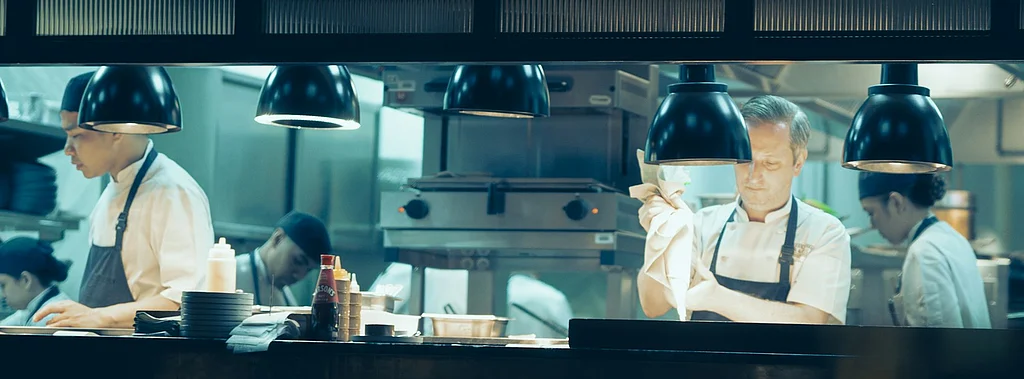
It started a few years before I graduated from school. Maybe I had watched too many movies about chefs, but back then, I wanted to become one myself. I regularly cooked for my family. At some point I even had my own plates just for plating my dishes. For me, it wasn't only about taste anymore. Presentation mattered too. If something didn't look good to me, it wasn't good.
After graduating at 17, I wasn't really sure what I wanted to do next. I remember going to a career fair where I ended up talking to representatives from a hotel. They told me I could spend three days with them, working my way through different parts of the kitchen to see if becoming a chef was actually something for me.
It wasn't just any kitchen either. It was a gourmet kitchen inside a luxury hotel.
So I went.
Living where you work
I didn't have to find a hotel room or somewhere else to stay for those three days. I was allowed to stay in the staff accommodation, which was also where I would have lived if I had started an apprenticeship there.
Wake up, grab some breakfast, and head into the kitchen. All within about 15 minutes. The entire day revolved around the different services. I woke up, ate, worked, took a break, worked again, and went to sleep.
Everything happened in the same place and for the same purpose.
What a day looked like
9:00 in the morning. That was roughly when my day started, although I later realized that I might have been allowed to start a little later because I wasn't actually part of the regular brigade.
The morning started with relatively simple tasks. Preparing fruit. Cutting up a pineapple. Making crêpes. Chopping and preparing whatever was needed.
This was already where I started noticing the difference between cooking at home and working a professional kitchen. At home, I would cook a dish. Here, I could spend the first two hours preparing ten different things without actually finishing a single dish. Everything was about the mise en place: getting every ingredient and component ready so that once service started, everything was exactly where it needed to be.
After breakfast service, we had a short break of maybe 10-15 minutes before heading back into the kitchen for lunch prep.
This was where a lot of the actual craft came in. Knife skills, preparing ingredients, organization, speed, and all the little fundamentals that you don't really think about when cooking at home. I remember learning things that sounded almost ridiculously simple afterwards. For example, not dragging the sharp edge of my knife across the cutting board when moving ingredients.
Then came lunch service and all the mise en place had a purpose. What fascinated me most was how quickly the atmosphere could change. Before service, people could talk to each other, joke around and laugh. Once orders started coming in and the pressure increased, the kitchen changed.
After lunch came the afternoon break. We had around three hours off. That sounds like quite a lot of free time, but in reality it mostly split the day into two shifts. Sure, I could go back to my room, lie down, and relax for a bit. But those three hours went by incredibly quickly.
And then it was time to head back into the kitchen. Dinner followed the same basic pattern: mise en place first, then service.
This was also where I got to learn more about actually cooking. How to properly sear something, how much timing and temperature matter, and how quickly you can burn your hands when working around hot pans all evening.
And then there was plating. That's one of the things I still remember well. Everything had its place. The presentation had to be precise and consistent. It wasn't enough for the food to taste right. It also had to look right when it left the pass.
At one point, I was plating caviar using a piping bag. That was a pretty surreal moment for me because, until then, I had never eaten caviar. I hadn't even seen it in real life. This was one of those small moments that made me realize just how far away this kitchen was from what I was used to cooking at home.
Which, considering my obsession with plating food at home, was probably exactly where my younger self would have wanted to be.
The cost of perfection
But that level of precision also left an impression on me for a different reason. The kitchen worked to a standard that, as a guest, you probably take for granted. If something on the plate wasn't right, it didn't go out. And sometimes that meant it went straight into the trash.
I was surprised by how much food I saw being thrown away during those three days. I understood the reason behind it. In a kitchen operating at that level, you can't just send something out and hope the guests won't notice.
But understanding it didn't make the waste bother me any less. There was a strange contrast to it. So much care went into every ingredient, every technique and every plate. But if the final result didn't meet the standard, none of that mattered anymore.
When service started
The change in atmosphere during service deserves its own section because it's one of the things I remember most clearly.
The work itself never really scared me away. Most of the time I actually enjoyed it.
During prep, the mood could be genuinely good. People talked. People laughed. Then service got closer, tickets started coming in and suddenly everything had to work at the same time.
Timing mattered. One station being late could affect another. A mistake didn't just stay a mistake. It could slow down the entire service. And the atmosphere changed with it.
I remember one of the cooks getting something wrong while working at the stove. I don't remember exactly what happened anymore, but it delayed things.
I do remember the chef shouting. A lot.
That's when you realize how different cooking professionally is from cooking at home. If I mess something up in my own kitchen, dinner is ten minutes late. During service, other people are waiting for you.
But I enjoyed it
At this point, this probably sounds like I'm building up to saying that I hated those three days.
I didn't. I really enjoyed working there. I learned an incredible amount in a very short time. I worked with food all day, learned techniques I had never even heard of before, and got to see how professional kitchen actually operates.
And I got to do the things I had always enjoyed doing at home: cooking, searing, experimenting with techniques, and plating.
The job itself wasn't the problem. It was everything around it.
The problem wasn't cooking
I still remember lying in bed around 10pm after one of those days. I was completely exhausted. During the shift, I hadn't really noticed it. There was always something happening, so I never thought much about being tired.
It hit me afterwards. And lying there completely exhausted at 17 made me realize that I didn't want this rhythm every day.
I mean, I still loved cooking. But I started to understand that a job isn't just its core activity. Being a chef isn't only about cooking. It's also about when you cook.
Restaurants are busiest at exactly the times when most other people are free: evenings, weekends and holidays. The three-hour break in the afternoon looked different when I realized why it existed. My free time would be structured around service just as much as my working time.
Maybe I saw it too strictly at 17. Maybe I would have had more free time than I imagined. But I knew I didn't want to build my future around work always coming first. Until then, I had mostly been asking myself what I wanted to do for work.
Those three days made me realize that I should also ask myself what I wanted my life outside of work to look like.
Cooking stayed. The career didn't.
We're often told to think about what we enjoy doing and then ask ourselves whether we can turn it into a career.
I hope everyone who genuinely enjoys something gets the change to make a living from it. But maybe there's another question we should ask first: Do I actually want the life that comes with this job?
Those three days for sure didn't make me lose my love for cooking. I still love cooking today (assuming I have the ingredients and the time). At least for now.
Maybe I'll come back to it in some distant future when AI has taken over my programming work and needs someone to cook dinner.